Monday, February 15, 2010

Mardi Gras 1976

Recently we've gone on a Facebook bender, belatedly (we're a late adopter, adapter, whatever), and primarily to reconnect with people we haven't seen, or not so much, in 20, 30, even 35 (!) years (as opposed to people we haven't seen in 5, 10 years––we always figure we'll run across them at Wal-Mart, or Whole Foods, or a Metro stop). We're naturally wary of anything as mind-habituating as Facebook, and very shortly we may be seeking out a 12-step program to cure us of this new enthusiasm, our latest in a long line of attention-deflecting addictions. The Facebooking, as we were warned it would, sent us stumbling down Memory Lane and into our "archives," a sturdy hatbox we've lugged with us for 30+ years and into which we've stuffed old photos, letters, unserved arrest warrants and such, and where we came upon the photo accompanying these words.

It shows a street scene during Mardi Gras, 1976, captured in the Hub City by our pal R-b, an avocational photographer who grew his own at home---that is, shot and "developed" his photos with chemicals and trays an so forth in makeshift closet-darkrooms. (How ... old-fashioned.) About 10 years ago we were visiting R-b at his southwest Houston home and remarked on how much we dug the photo, and he asked---or, to be accurate, demanded––that we take it off his hands and never return it. We said, "Sure,"* because this picture speaks to us on many different levels and draws forth a wealth of associations--most all of them blue-sky happy, in their way.

We're not 100-percent positive of the photo's vintage, but the movie advertised on the marquee was released in 1976, according to various authoritative Internet sources (and starred Elliot Gould and Diane Keaton––we never saw it and don't even wanna know what it's about). It's obviously from some time in the '70s, as you can tell from the gent in the foreground with the shades and form-fitting denim and the extremely boss hat (all of which he may have purchased down the street at an establishment called Right On Fashions, which last we looked was still extant, with a somewhat updated and hip-hop-ized selection of couture). It was for-sure taken at Mardi Gras––R-b confirmed this for us––and froze a typical instance of street-dragging on Shrove Tuesday, possibly between parades (there was the big "white" one in the a.m. and a "black" one at 1 p.m.). The street is Jefferson and the theater likewise was the Jefferson. (For recently arrived immigrants or students who failed their 8th grade U.S. history TAKS exam, this "Jefferson" was un presidente de Los Estados Unidos who swung the steal of the century [19th] when he "purchased" a broad swath of the North American continent, then called "Louisiana," at a fire-sale price from this dude Napoleon, who was kinda like the mack-daddy or whatever you call it these days of this country called France, which is in Europe, thus doubling the size of los Estados Unidos and priming future generations of Yankee Traders to [thank God] steal most of the rest of the continent from Mexico.)

The movie title, of course, speaks to us across the years of the fleetingness, the ephemerality, of time and desire. The theater is long-gone, razed at least two decades back. It was where, we believe, our father took us to see The Man Who Shot Liberty Valance--why, we have no idea, as it was the only time we remember him taking us to a picture show, although he took us lots of other places. Some years later, right out front there, we had a non-Mardi Gras Epiphany or revelation of sorts, after our mother had dropped us and some other goofballs off to catch a Saturday afternoon matinee of an Elvis movie (which one we can't recall––they were pretty much all the same after Kid Creole, and all good). While standing in line we noticed something we had never noticed before, although it may have been there all along, right in front of us, and that was the presence of a second line of youngsters at a smallish ticket window off to the side. The kids in the other line, we noticed, were all directed by the manager up the side stairs to the balcony. We took our seat, unwisely, on the floor just in front of the balcony's edge, and sometime during the movie a shower of popcorn and ice rained down on first-floor customers, causing considerable commotion as the ushers hoofed it upstairs to police the antisocial behavior. Although at the time we did not enjoy that uncomfortable, sticky sensation, if we ever meet a black man or woman our age who was in the balcony that day to watch Elvis we'll ask them if they threw ice or popcorn on us, and if he or she says "No" we'll ask "Why not?"

But mostly this picture makes us think of Mardi Gras, and all the great fun we had, from the time we were a little kid until late adolescence and early adulthood, running wild and free and mostly unsupervised with boon companions through the downtown streets of the Hub City. How we discovered those hidden spots--like the bleak, urine-stained pedestrian passageway that ran alongside the underpass beneath the train tracks, and still may--and how we found you could traverse a good portion of the downtown by going roof-to-roof atop the adjacent storefronts. How blue the sky looked, and how there seemed to be no boundary between that blue sky and our mind, on the Mardi Gras Day when we experienced a bit of heightened consciousness and stood staring upward, transfixed, right there on Jefferson Street. How at 11 or 12 we threw up after gorging our self on junk at the street carnival that was always staked at the foot of Jefferson, and how we subsequently spent what seemed like two long, queasy hours searching for a usable pay phone so we could could call our parents to come and get us. How, going back to when we were 5 or 6, before we were running wild and free, we were forced to costume-up in a "Confederate general's" uniform--with epaulets!--that our Granny, bless her, had lovingly sewn for us. And much later on, how we'd unhesitatingly hook up with––in the dated sense of the term, meaning hang out with--people we didn't know and would never see again after that Tuesday.

We learned some other stuff at Mardi Gras, too, like what Hemingway (or we think it was Hemingway) meant when he said that one of the educational advantages of growing up in a small town is that you come to realize why the man with the big cigar has the big cigar. In our case, it was realizing why the man on the float in the crown, robe and fake beard was on the float, while we were down on the street with the jostling throngs waving our hands and begging him to toss us some plastic junque.

And it was, truly, all good.

We don't know anybody in the picture, but we know everybody ... the little fellow with his dad, walking purposefully off to the right ... the pig-tailed girl in the back, turning to look down at something on the street, maybe something she stepped on, or in ... the little girl in the foreground, gazing up pleadingly at her father, with the look of distress, maybe ... her father in the boss hat, waking tall and proud with his shoulders back and the pretty-good-lookin' woman with the popcorn at his side ... Everybody happy, or sad, or happy-sad ... stunned, expectant, searching, hungry ... dragging the street ... throw me something, mister ... in the moment we call "now" that's always passing.

*Dialogue guaranteed verbatim.

Sunday, February 14, 2010

Two Kinds of Smart

We were kibitzing just yesterday with a couple of the Korean kids with whom we work on the weekends, when we pretend to instruct them in the finer points of some of the liberal arts (a Chinese guy handles the math). They are first cousins, a girl and a boy, in 8th and 9th grade respectively, and both either were born n the U.S. or came here while very young. Thus they are thoroughly assimilated--the male, a husky kid with an athlete’s swagger, runs track and plays football, or did; the girl, who possesses a droll and perhaps even overdeloped sense of humor for an 8th grader, is not only good at math but draws extremely well and speaks much like our own 10th grader, with the prevailing adolescent female vocal tendency to occasionally turn a declarative sentence into an interrogatory. They also, as we probably shouldn’t add, are both very “good with people,” which we’ve noticed is not a naturally occurring trait among many Koreans in the United States. (We could be misimpressed, though.)

Our conversation turned to a third kid who’s usually with them , another Korean who’s only been in the country for a couple years and who we mistakenly thought was a third first-cousin but apparently is only a good friend. They explained he was absent because of a proir commitment having something to do with “science,” perhaps the science fair, although this engagement sounded a little more elvated than the district-wide UIL competition (maybe not, though).

“He’s really, really smart” said the girl, as her cousin nodded along.

“Yeah, but you guys are real smart, too,” said we, not only as conversational space-filler but because it’s true.

“Yeah,” sighed the girl, “but we’re, like, um ... American smart”--and here she raised her hand to eye level, giving the internationally recognized signal for about this high--”and he’s like, Korean smart”--and here she raised her hand clean above her head.

“You mean,“ said we, raising our own hand very high above our noggin, “like Korea Korean smart?"

“Yeah!” said they.

Recommended further reading and listening on this topic.

Friday, February 12, 2010

Smucker (Rhymes with Pucker) for Guv

Ordinarily we assign no value whatsoever to pronouncements by "political consultants," be they Republican, Democrat, Libertarian or Rosicrucian. We've found, based on extensive past experience, that any utterance issued for public consumption by a hired-gun political type has only the most tenuous relation to the truth, or even thruthiness. However, the tart observations regarding hometown Dem gubernatorial contender Bill White that gut-punching, 'nad-slapping GOP consultant Allen Blakemore provided the Houston Chronicle's Joe Holley (or so Holley reported––we were not a party to the alleged conversation) certainly had the tang of truth, or truthiness, delivered, as they were, in the spirit of fun and bitter partisanship:
In addition to questioning White's business acumen, Blakemore wondered whether his mayoral persona — a wonkish guy with ears and hair made for radio — will effectively translate to a race for governor. “His schtick became, ‘I absolutely, positively couldn't be a politician and speak as poorly and to present as poorly as I do.' It's the old, ‘with a name like Smucker's, it's got to be good' routine.”

A mayor, Blakemore contends, can get away with portraying himself as a colorless, competent technocrat. It's harder, he says, for a statewide candidate in Texas, where the relatively weak office of governor is about symbol as much as substance.
This is pretty much in accord with our own trenchant insta-analysis, delivered in the spirit of fun, hard science and non-partisanship following the one and only televised debate between White and some foreign-sounding guy who definitely lacked Rick Perry's easy "Adios, mofo" insouciance. This synchronicity is most likely a case of weak minds thinking alike, or recognizing the painfully obvious.

Holley's story also touched, glancingly, on a matter we've long suspected would be raised when (not if) White sought statewide office, one that we don't remember getting a whole lot of traction when he first ran for mayor, although we were temporarily retired from the punditry and blogging game at the time ("blogunditry") and not paying full attention:
White's Republican opponent also will try to portray him as a less-than-successful businessman in years past. It's a tack his Democratic primary opponent, Houston hair-products magnate Farouk Shami, has attempted, charging that White's initial business venture, Frontera Resources, exploited contacts he made in the Energy Department to seek oil and gas opportunities in the former Soviet Union. His Republican opponent likely will make much of the fact that Frontera lost its assets in Azerbaijan after defaulting on a loan and that the company reported $23.8 million in losses in its two most recent quarters.
We did notice that White, whose primary pre-mayoral vocation was that of "trial lawyer," was quite insistent during this week's debate when plumping his business credentials, suggesting that he and his have been practicing a detailed line of rebuttal to that expected attack.
Despite these potential vulnerabilities, White remains a viable, highly marketable alternative to Mofo Perry, not having (at least thus far) gone out of his way to alienate the state's largest bloc of voters or questioned whether the U.S. government had a hand in 9/11.

So he's got that going for him.

Thursday, February 11, 2010

A Brief, Polite Throat-Clearing (Ahem) on the Subject of the Recently Departed Charlie Wilson

We liked Charlie Wilson as much as the next Texan, probably for most of the same reasons. It’s unlikely that a rough-hewn sort such as Wilson, who would have had difficulty finding himself a sponsor for a deaconship in the First Baptist Church, could get elected to high public office in Texas these days, although Wilson, once in, was the sort of Democrat who could have been re-elected in perpetuity, health permitting. Wilson did a lot for veterans but the greatest thing he did was helping to create the Big Thicket National Preserve (a project, of course, that required, and requires, many other hands). There was no Tom Hanks movie on that effort, nor will there be.

There is, however, one item on Wilson’s CV that gives us pause, and that is the matter for which he will be best-remembered, thanks to the Hanks movie and the George Crile book on which it was based. For some reason, a congressman’s engineering of a covert CIA-backed war with taxpayer dollars and without public sanction is considered a grand, praiseworthy endeavor, blindly celebrated, or so it would seem, in most of the obituaries we saw in the Texas media. (Here’s an otherwise very good and highly literate one from Channel 13’s Ted Oberg, in which the “charm” of Houston socialite Joanne Herring and Wilson’s ability “to secretly appropriate $500 million in U.S. tax dollars” are credited with having helped the Afghan rebels send the Soviets packing. The New York Times story on Wilson’s passing set the figure for U.S. support at “$750 million a year” throughout the 1980s.) This is the sort of notion that offends the proud isolationist in us and makes the little William Jennings Bryan inside (you’ve got one, too, although maybe you haven’t gotten in touch with him) want to roll up his sleeves, take to a lectern and began declaiming in an overwrought, Frederic March-like lather. True, this particular intervention did not require the expenditure of American blood, only tax dollars, and we suppose upending the Soviets to inadvertently pave the way for the Taliban might have seemed like the right thing to do, at least for a while, even though things didn’t work out so well for us taxpayers on down the road.

We did not read the well-regarded book on which the movie was based, but the film, if we remember correctly, did take note of the unintended consequences of Charlie Wilson’s War, which we won’t bother to enumerate here, aside from mention of Bush’s Obama’s continuing war in Afghanistan. One local station, Channel 11, also referenced the aftermath of that secret war, even hauling out Herring––who appears to have supplied her own creamy-dreamy backdrop for her interviews with both 11 and 13––to provide this shrugging acknowledgement of the vagaries of history: “You can’t predict future wars.”

As William Jennings Bryan could have told her.*

*If he hadn’t died four years before her birth (!?!).

Tuesday, February 09, 2010

Shami + White = Sleepy Time (With Mexican Sunshine!)

The lone televised Bill White-Farouk Shami debate before the Democratic gubernatorial primary*––an event watched by perhaps dozens of voters across Texas––was a major snooze-inducing disappointment, primarily because Shami failed to say anything really off-the-wall or lay down some of the gratuitous nastiness he'd been laying down when out of White's earshot. Of course, we're not 100-percent positive Shami didn't say anything truly outrageous, because, frankly, we had a difficult time understanding a lot of what the native of the West Bank (not of the Brazos) said.** In fact, we were hoping that White, after Shami had reeled off a long, winding, half-sensical ask-your-opponent-a-question query,*** which had something to do with "butadiene" and "benzene" (or, maybe, "Benzedrine"), was going to pause for a beat and reply, "Would you repeat the question?" Now that would have been nasty!

But that was not to be, because White was there not so much to debate Shami as to tune-up for his expected main bout with Rick Perry. Shami, however, was not a worthy sparring partner. White even seized on the relative sedateness of the hour-long (seemed like two,) encounter when he asked voters to note that he and the well-coiffed hair-care products manufacturer had "treated each other with respect"--not like those impolite Republicans who were "shouting" over one another and throwing gang signs, etc., during their debates.

We did not keep a scorecard, because this wasn't really a sporting encounter worthy of scoring, but we must offer the following observations, annotated by the cold light of morning:

1. White seemed up-tight and bit constricted in the early going, wearing a strained grin that he couldn't seem to wipe off until one or two questions in. He settled down later, but somehow he needs to project his sittin'-'round-the-council horseshoe persona. Otherwise, he just won't show when he debates Sr. Perry, the unacknowledged promotional genius of Texas politics.

2. Shami needs to learn how to pronounce "moratorium," especially since he's calling for one on executions. White wisely rejected that notion out-of-hand, knowing full well that no one's getting elected governor of Texas by promoting a stay on the death house action. The ex-mayor, who we suppose did not have to add that he's against executing the innocent, also set forth a rather stout defense of the current criminal justice system, which he described as "for the most part" just (or something close to that--our notes are squinchy and hard to read). We'd bet this did not sit well with the editor of the Houston Chronicle or his wife or their new favorite author, but it's unlikely to keep White from winning the newspaper's endorsement. It's also the correct position.

3. White also came on like a tough guy on potential voting abuse, declaring that any "non-citizen" caught voting should be "investigated," "indicted" and then "serve time" (Ouch!) ... but, of course, he couldn't bring himself to stray from the party line and endorse the display of a photo I.D. as a requirement for voting. This is why Democrats can't win a statewide election, in case you were wondering.

4. The one indisputable Shami-esque moment came when the hair-care magnate, in answering some question on border control, said––and we believe he was grinning wildly when he did––"Without Mexicans it would be like a day without sunshine." (By which he meant, if we can interpret: "A day without Mexicans--that is, people from Mexico, as opposed to Mexican Americans--is like a day without cheap, easily exploitable labor.") At first we weren't sure we had heard him correctly and scribbled in our notes, "w/o Mex.s=day w/o s-shine????", but according to subsequent news reports our ears had not betrayed us.

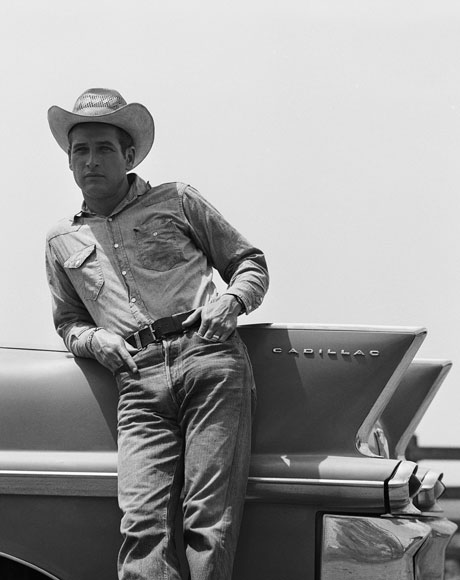
5. White will have a difficult go of it facing-off against Perry, who during the Republican debates was affecting a very pronounced Paul Newman-as-Hud swagger and smile. (Unfortunately, K. B. Hutchison is no Patricia Neal, either in the brains or the smouldering, self-possessed sexuality department, so their verbal confrontations lacked the snap of the movie's.). White, meanwhile, seemed to be channeling Arnold Stang, with a Texas accent, during the first few minutes of Monday night's debate.

So you got Hud in a top-down Caddy vs. some smilin' bald guy from Houston. How do you think the odds stand right now?


*The field also includes five other candidates who, as the debate moderator noted, "did not meet the criteria" to participate in the debate, meaning "they aren't rich like Shami and White."
**Unlike some minor local media celebs, we would never mock or belittle someone for the way they talked, because our parents raised us better, but we do believe that communication is one of the key duties of a governor and therefore he or she should have the ability to make himself or herself easily understood.
***Allowing candidates to "question" their opponents during televised debates is a horrible idea that needs to be abandoned immediately, as these question-posings are just another occasion for the candidates to deliver some of their canned ham.

Sunday, February 07, 2010

The Good Life: It’s Still Bad, In Case You Were Wondering (Updated)

Readers who’ve kept up with their daily dosage of ginko biloba will recall that it was only last Monday when we wrote, in an uncharacteristically derisive tone, of the Houston Chronicle’s new The Good Life section and how that misguided effort at content delivery, or whatever it’s called, had contributed to the scenic blight in our neighborhood. We intended to say no more on that subject, ever, at least until the “Looking Back” retrospective we’re planning to commemorate our 10,000th posting, but subsequent to that trenchant examination of The Good Life we were contacted by someone claiming to be a Ms. Kyrie O’Connor, who in an initial emailing identified herself as “deputy managing editor/features” of the Chronicle. (Having never had the pleasure of meeting her in person, we can’t of course say for sure that the human with whom we communicated was indeed Ms. O’Connor, so we must hedge a bit; if it were some prankster-imposter we’d like to apologize to the real Ms. O’Connor here and now.) Ms. O’Connor, or the Ms. O’Connor impersonator, claimed that our handiwork of Feb. 1 was rife with what she called “wrong facts,” a not-too-clever formulation she attributed to an anonymous co-worker. In a follow-up phone conversation of seemingly unending duration she scolded us, quite mercilessly, for failing to open the sandwich-baggy-like wrapping of which we wrote and inspect a copy, or copies, of The Good Life that were pitched on the lawns of non-Chronicle-subscribing residents of our neighborhood, which she described as a whole ’nother product, or sort of a whole ’nother product, or in some way kinda-sorta different, a little bit, than the one that was home-delivered that Sunday to paying subscribers such as yours truly (and possibly non-paying ones). We explained––or tried to explain, as we found it difficult to squeeze in more than a desultory defense here and there during the wide-ranging conversation––that we are not a thief, at least not anymore, and that making an unauthorized entrance into a sandwich bag to retrieve a Good Life from a neighbor’s yard might constitute theft under Texas law. We did not add, for we did not feel the need to, that in our neighborhood many residents possess not only BAD DOGS but loaded firearms that more than a few probably leave lying around the living room with the safeties off. (In fact, our next-door neighbor, who is recently returned from a spell in the V.A. Hospital after suffering a serious stroke, within the past year or so failed to follow the rules of handgun safety when he drunkenly waggled what he described as a “loaded” .357 magnum in our presence, though not directly at us, while supine on his bed near the open window where he passed most of his hours, pre-stroke. It was just 2 o’clock on a Saturday afternoon, and at the time we had not even thought of stealing his The Good Life, nor, most likely, had the Chronicle’s master marketeers brainstormed it into existence.)

Anyway, as Ms. O’Connor surely understood from her close reading of our posting, we were not moved to throw down on The Good Life until we noticed so many copies still lying on our neighbors’ lawns late Monday afternoon, which by that time had been turned to gelatinous wads of newsprint mush by the heavy rains, thus rendering them extremely difficult to read (although we fully understanding that “reading” The Good Life is not the point of The Good Life). After many minutes of pleasant exchanges with Mr. O’Connor––we hate to be so formal, but for some unexplained reason Ms. O’Connor refused our request that she tell us how to say her first name, and we’d feel uncomfortable referring to her in print by a name that we might mispronounce aloud––we established, solely on what we believe to be Ms. O’Connor’s good word, that a story we may have suggested was in the yard-pitched non-subscriber copies of The Good Life, a story having something to do with vacationing in Aspen (which we cited, among others, to suggest that the newspaper’s marketeers were overshooting the demo in our zip code), appeared only in copies of The Good Life that were tucked into subscribers’ home-delivered Chronicles. (Are you hanging with us here?) After more pleasant repartee with the deputy managing editor/features, we further established––again, based on Ms. O’Connor’s good word, as we still have not screwed up the courage to steal a sodden week-old copy of The Good Life, although many are still available hereabouts––that the other two stories we cited, having to do (we think) with Creole cookin’ and Parisian couture––were indeed in both (that is, presumably, all) versions of The Good Life, subscriber and non-subscriber.

Also on Mr. O’Connor’s short bill of non-particulars was the allegation that we somehow had mischaracterized the commercial imperative behind The Good Life by suggesting that this episode of legalized littering apparently was meant to spur subscription sales.* In retrospect we see how stupid this conjecture of ours was, because obviously the last thing a daily newspaper needs these days is more paying subscribers. (What The Good Life is aiming to do, you see––and once again we rely solely on Ms. O’Connor’s expert testimony.––is simply to serve as a much-needed vehicle for the delivery of ad content to non-subscribers. Pure genius, no?) Additionally, Ms. O’Connor seemed disturbed, or pretended to seem disturbed, by our jesting suggestion that The Good Life had been hand-delivered by Chronicle publisher Smilin’ Jack Sweeney, although after some moments of intense palavering we believe we were able to wring from her the admission that she well-knew we were only playin’.

Ms. O’Connor had a whole lot else to say, most of which we did not commit to memory because it did not seem at all relevant to the matters at hand, although we do recall her bald and somewhat unscientific assertion that, and we quote, “Your blog is crap.” We took exception to the declaration but did not argue the point at length, since it is not entirely outside the realm of possibility. (Mrs. O’Connor at one point also mocked, or tried to mock, our vocal mannerisms, which we sort of let pass because we were multitasking at the moment; we did, however, verify the attempted mimicry by asking whether she was “mocking” us, to which she replied: “Yes, I’m mocking you.”)

The deputy managing editor/features seemed overly het-up about the entire matter, which had the effect, perhaps the intended effect, of making us equally het-up and forcing us to retreat from our backyard to the interior of our domicile so as not to disturb our neighbors with the increased volume (we’re thoughtful that way). Oh yeah, we almost forgot: To illustrate the egalitarian impulse behind the standalone yard-pitched version of The Good Life, Ms. O’Connor informed us, possibly with a straight face, that a big story in the upcoming edition had something to do with a “$7.99 ring you can buy at Target.” To our joshing query as to whether Target had “paid” for the story Ms. O’Connor seemed to take serious umbrage, and later, in reeling off a long list of our various sins of commission and omission, she claimed that we had accused her, personally, of taking a “bribe” from Target. (After sobering up, however, it seems clearer to us that the pimping of a purchase, no matter how small, from a major advertiser is––and we’re being polite here––a tad unsavory and possibly in contravention of the ethical standards of Sigma Delta Chi, if not the Geneva Convention.)

Alas, the conversation, after not advancing especially far, reached an impasse, with Ms. O’Connor accusing us of a (her word) “Birther”-like solipsism (our word) for our steadfast refusal to acknowledge any wrongdoing or malfeasance. Mrs. O’Connor, whose own solipsism rivals that of our sitting governor––and we hope she understands what we mean here, and it’s not altogether a bad thing––remained similarly unyielding in her professed belief that The Good Life is NOT mere crap and that a story on a “$7.99 ring you can buy from Target” rises to the level of “journalism,” broadly defined.

We do, though, occasionally acknowledge the validity of others’ realities, in addition to being an open-minded and big-hearted sort, so very early this morning we gave The Good Life another shot, reading (sort of but not really) not only the one in our home-delivered edition but discreetly “borrowing” one from a slumbering neighbor’s yard under cover of darkness (which we’re returning shortly, FYI). Here’s what we found:
Our 8-page Good Life: Two travel stories on Big Sur and snuba-ing in Honduras not in our neighbors’ dowdy downscale edition, as well as a tout for some beer from Southern Star Brewing Co. of Conroe (at least it’s local, but, hey, did they pay for that?) and some personal-fitness shinola.

Our purloined 6-page Good Life: All, or most all, of the rest of the schizz in the subscriber-only version, plus a Parade magazine, several ad inserts (coupons!) and––check it out––a very large advertisement for Carter's Country, where one of those Glock Model 27s can still be had for only $559.97 (maybe the Chronicle's better at the demographic fine-tuning than we thought). Cover "story" is “Hello Sailor!”, which, contrary to the headline suggestion, is not about port-side prostitution but enjoins readers to “Get nautical this spring with stripes that will take you to the yacht club” (for your job clearing tables, we guess). This appears to be the story involving the $7.99 ring from Target of which Ms. O’Connor pridefully spoke.
Sad to say, but we must conclude, oh-so-predictably, that The Good Life, in however many permutations it may be available in our expanding universe, is still crap. Yet we hope this fact-opinion, empirically verifiable though it may be, will not present an obstacle to our remaining a fast and loyal Facebook buddy of Ms. O’Conner, and she of us, until this good life draws to its inevitable close.

As for The Good Life, the newspaper section: We predict its end will be coming within the month, two at the outside. But we could be wrong!

*After posting this entry, which surely will be a finalist in the Pulitzer competition for Superior Blogurbatin', we were returning the contents of The Good Life sandwich bag for re-delivery when we noticed that it included a flier offering "complete Sunday Chronicle delivered for $1.00 a week!" Ms. O'Connor stands corrected.

Friday, February 05, 2010

Stein Watch: The Professor and the Wedge Not-Wedge

We know--we've been falling down on the Bob Stein Watch job. But it would be a 'round-the-clock task keeping up with the public utterances of Rice University's Lena Gohlman Fox Professor of Political Science. Fortunately, Stein Watch is a collective effort, and one of our correspondents has called our attention to some Stein-ian verbiage that graced a story on NewsRadio 740 KTRH regarding the "first gubernatorial ad" by our own ex-alcalde, Bill White. How to explain the ad's "focus on education"? Call 1-800-YOU-NEEDA-QUOTE and ask for "Bob," or "Robert," when the occasion demands [the following is lifted verbatim from the station's Web site, without the necessary corrections, which ordinarily we might be moved to make but which we're just not in the mood to fool with at present]:
“You’ve got lots of suburban school districts which are Republican based that are suffering under the new tax reforms and tax cuts—Cy-Fair, Goose Creek, Klein—that are not able to meet their payrolls—that are not able to meet their increasing demand” said Rice University Political Scientist Bob Stein, adding such a focus covers much of the political spectrum.

“It’s a kind of wedge issue that isn’t a wedge. It’s actually a bridge between two important political constituencies—suburban Republican voters who have young children in public schools—and growing urban areas—particularly in the Valley, San Antonio, El Paso, where there are growing Hispanic populations” Stein said.

In the end, Stein said the strategy is pretty easy to understand.

“What you’re beginning to see is Bill White try to fashion a campaign strategy that anticipates that Rick Perry will be the (Republican) nominee—the Kay Bailey Hutchison will not be the nominee” Stein said, seeing a push for Republican voters who may be looking for more Progressive leadership.
Our correspondent, a droll sort, even went the extra mile to help us polish off this installment of Stein Watch:
You need a quote? Here's one: "Didn't his wife work for White?"